Trigger interface
Confirm the camera or controller output and the illuminator input before sampling.
 IR & Project Lighting
Triggered IR Product Family
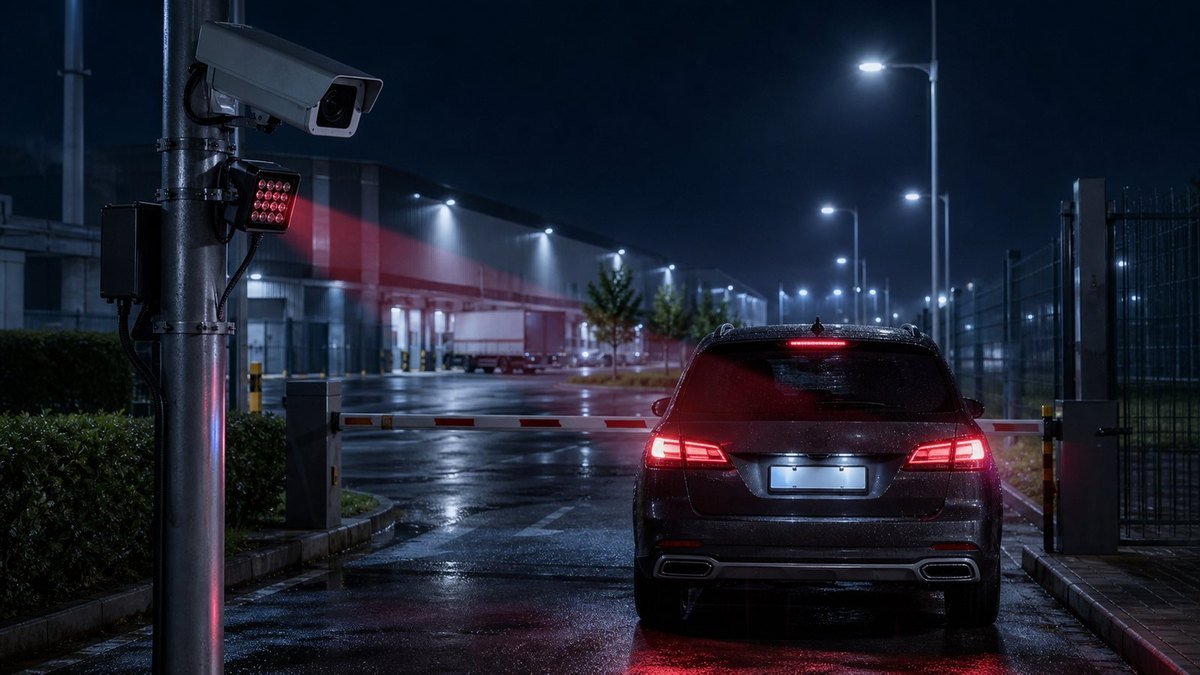
A strobe IR illuminator delivers light in coordination with a camera or capture event instead of remaining continuously on. It is considered for ANPR, access control and traffic imaging when trigger type, exposure timing, plate distance, vehicle speed and lane geometry can be reviewed as one system.
Decision First
Confirm the camera or controller output and the illuminator input before sampling.
Align the light pulse with shutter and capture timing; do not assume default compatibility.
Record vehicle direction, plate position, camera angle, distance and mounting height.
Review installation, road-use and local compliance requirements for the project.
Selection Snapshot
| Capture condition | Lighting direction | Critical verification |
|---|---|---|
| Controlled gate | Triggered focused IR | Camera output and plate zone |
| Parking lane | Strobe or continuous, based on exposure strategy | Vehicle speed and barrier workflow |
| Traffic checkpoint | Synchronized capture lighting | Timing, glare, lane geometry and local rules |
| General surveillance | Continuous IR may be simpler | Whether every frame needs illumination |
Strobe illumination is useful when a camera needs a concentrated burst of light for a defined capture event. Typical discussions include parking entrances, vehicle gates, checkpoints and traffic-camera projects.
It should not be selected from wattage alone. Trigger voltage or contact type, pulse timing, camera exposure, frame strategy and required duty cycle must be compatible.
Measure the plate capture point, camera-to-plate distance, illuminator offset, mounting height, horizontal and vertical angles, vehicle direction and expected speed. These factors determine whether the beam reaches the plate zone at the right angle.
Reflective plates can saturate if exposure or illumination is too strong, while an overly wide beam can waste light. Sampling should be performed with the final camera and representative plates.
The illuminator can support capture, but it cannot guarantee a recognition percentage. Camera optics, shutter, sensor, firmware, plate condition, traffic movement and recognition software all contribute to the result.
Accurates can review lighting requirements and model options. The integrator or project owner should validate the complete capture system before rollout.
Project Recommendation
Send the camera model, trigger information and lane drawing. We will identify the open questions and suitable lighting direction.
Clear Answers
No. Some controlled lanes work with continuous IR, while faster or event-driven capture may benefit from synchronized light. Choose from the camera and lane strategy.
Share the camera or controller output type, voltage or dry-contact behavior, exposure timing, capture frequency and connector expectations. Confirm against the final datasheet.
No. Lighting supports image capture, but recognition depends on the complete camera, optics, settings, lane, plates and software. Test the integrated system.
Provide a sketch or photos showing distance, target width, mounting height, camera and light angles, vehicle direction, speed range and capture point.

