Camera lens
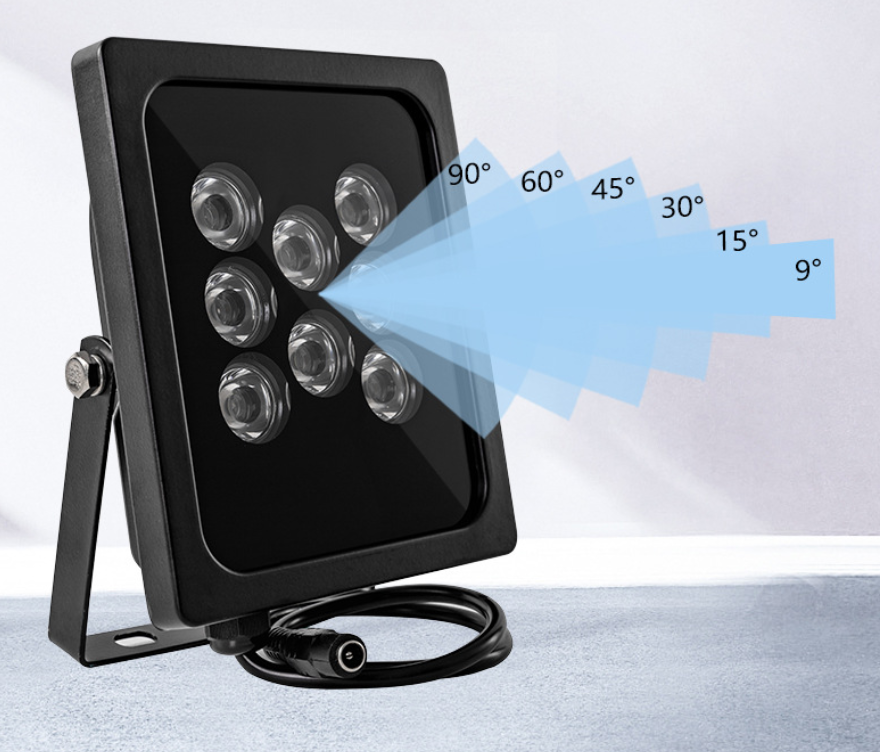
A telephoto view usually needs a controlled, narrower illumination footprint.
 IR & Project Lighting
Long-Range IR Product Family
Long-range infrared illumination should be designed around the camera lens, target width and environmental conditions, not a single catalog distance. Narrow-beam LED, laser or VCSEL directions may be considered, but the usable result must be validated with the intended camera, mounting and weather conditions.
Decision First
A telephoto view usually needs a controlled, narrower illumination footprint.
Define the width and depth that must remain visible, not only the farthest point.
Fog, rain, dust and airborne moisture can scatter infrared light and reduce contrast.
Allow practical aiming, mounting stability and commissioning adjustment.
Selection Snapshot
| Optical direction | Best-fit discussion | Main limitation |
|---|---|---|
| Narrow-beam LED | Focused fixed scenes | Alignment and hotspot control |
| IR laser / VCSEL | Longer-distance or tight-beam projects | Camera compatibility, speckle and model-specific behavior |
| Medium beam | Balanced width and distance | May not cover a very wide near field |
| Multiple illuminators | Wide or segmented perimeter | Overlap, power, aiming and maintenance |
Published ranges are normally measured or estimated under particular conditions. Camera sensor, lens aperture, target reflectivity, humidity, rain, dust and exposure settings can change the usable image substantially.
For procurement, define the required target and acceptance test. A representative night trial is more reliable than selecting only from the largest distance number.
A narrow beam can place more light on a distant target but demands accurate alignment and may leave the near field dark. A wider beam covers more area but spreads energy across a larger footprint.
For PTZ cameras, one fixed illuminator may not match every zoom and pan position. Discuss whether the project needs a fixed observation zone, coordinated optics or multiple illumination positions.
Provide camera and illuminator mounting positions, the lens field of view at the required zoom, target dimensions, power availability, control method and environmental exposure.
Final commissioning should check focus, gain, shutter, backscatter, reflections, hotspot uniformity and edge coverage. Accurates supplies product matching support; the complete scene must be approved by the project team.
Project Recommendation
Send the camera lens, target width, distance and mounting layout. We will help turn the site requirement into a testable lighting specification.
Clear Answers
There is no universal usable distance. It depends on model, beam, camera, lens, target, settings and weather. Define a target zone and validate it in representative conditions.
Only if it matches the camera field of view and can be aligned reliably. Too narrow a beam can miss the target or create uneven coverage.
Catalog sources show selected long-range laser or VCSEL directions. Exact availability, wavelength, beam, voltage and housing must be confirmed by model.
Send the camera and lens, target distance and width, mounting drawing, environment, wavelength preference, voltage, control method and acceptance target.

