Discretion need
Clarify how important low visible glow is compared with practical image range.
 IR & Project Lighting
940nm IR Product Family
940nm infrared illumination is considered when a lower visible emitter glow is important. Camera sensitivity at 940nm can be lower than at 850nm, so buyers should confirm sensor response, required distance, beam angle and image quality with the intended camera before specifying a model.
Decision First
Clarify how important low visible glow is compared with practical image range.
Check the camera datasheet or run a night test because response at 940nm varies.
Use the target zone and camera field of view to define coverage.
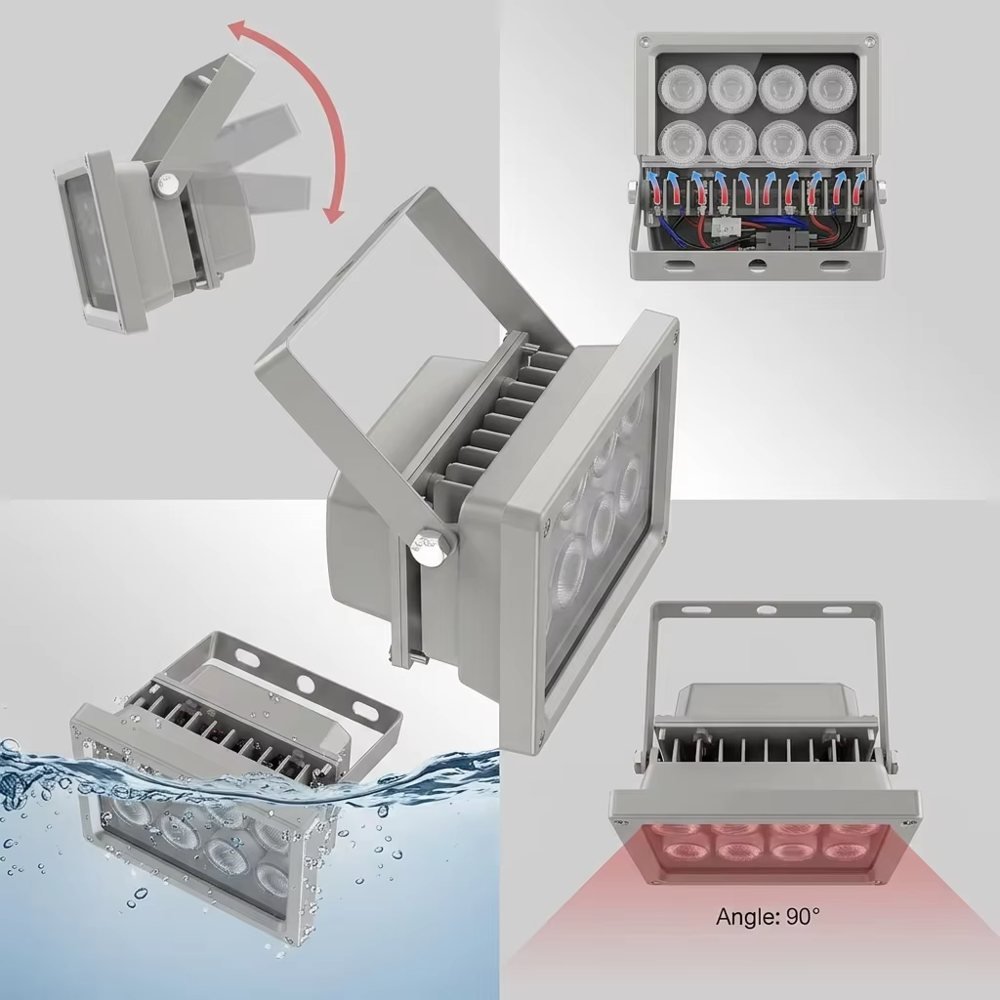
Confirm voltage, control, housing and mounting requirements for the site.
Selection Snapshot
| Project condition | 940nm may fit when | Main check |
|---|---|---|
| Discreet monitoring | Lower visible emitter glow is important | Camera response at 940nm |
| Short or controlled scene | Distance and target zone are clearly defined | Night image quality with the real lens |
| Outdoor security | A suitable outdoor housing is selected | Weather, reflections and mounting |
| Vehicle capture | Camera and lighting can be tested together | Exposure, plate reflection and trigger strategy |
940nm can reduce the visible red glow associated with some infrared emitters, which can be useful for discreet monitoring. It is not automatically a longer-range or higher-performance choice.
The trade-off is camera-dependent. Some sensors deliver less usable signal at 940nm, so the same scene may require a different beam, output level, lens or exposure strategy than an 850nm installation.
Evaluate the camera in monochrome mode with its production lens, IR-cut behavior and intended exposure settings. A specification sheet alone cannot show how every camera will perform in the target scene.
During sampling, check center and edge brightness, motion detail, reflective surfaces and whether the target remains usable at the required distance.
Catalog sources show 940nm configurations across selected models, beam options and housings. Availability is model-dependent and should be confirmed on the final datasheet and quotation.
Accurates provides the illuminator and matching guidance; final surveillance or recognition performance remains a complete-system test responsibility.
Project Recommendation
Send the intended camera and scene details. We will help define a test configuration without promising an unverified distance or image result.
Clear Answers
It is better described as low-visible-glow or discreet infrared. Perceived glow depends on the emitter, viewing distance and conditions, so avoid treating it as an absolute invisibility claim.
Not necessarily. Many cameras are less sensitive at 940nm, but the result varies by sensor, lens, beam and settings. Compare both wavelengths with the intended camera.
Yes, when the selected model has a housing, voltage and mounting arrangement suited to the site. Confirm the exact model rating rather than applying one rating to the whole range.
Send the camera model, lens or field of view, target distance and width, mounting height, voltage, control method, quantity and destination.

